

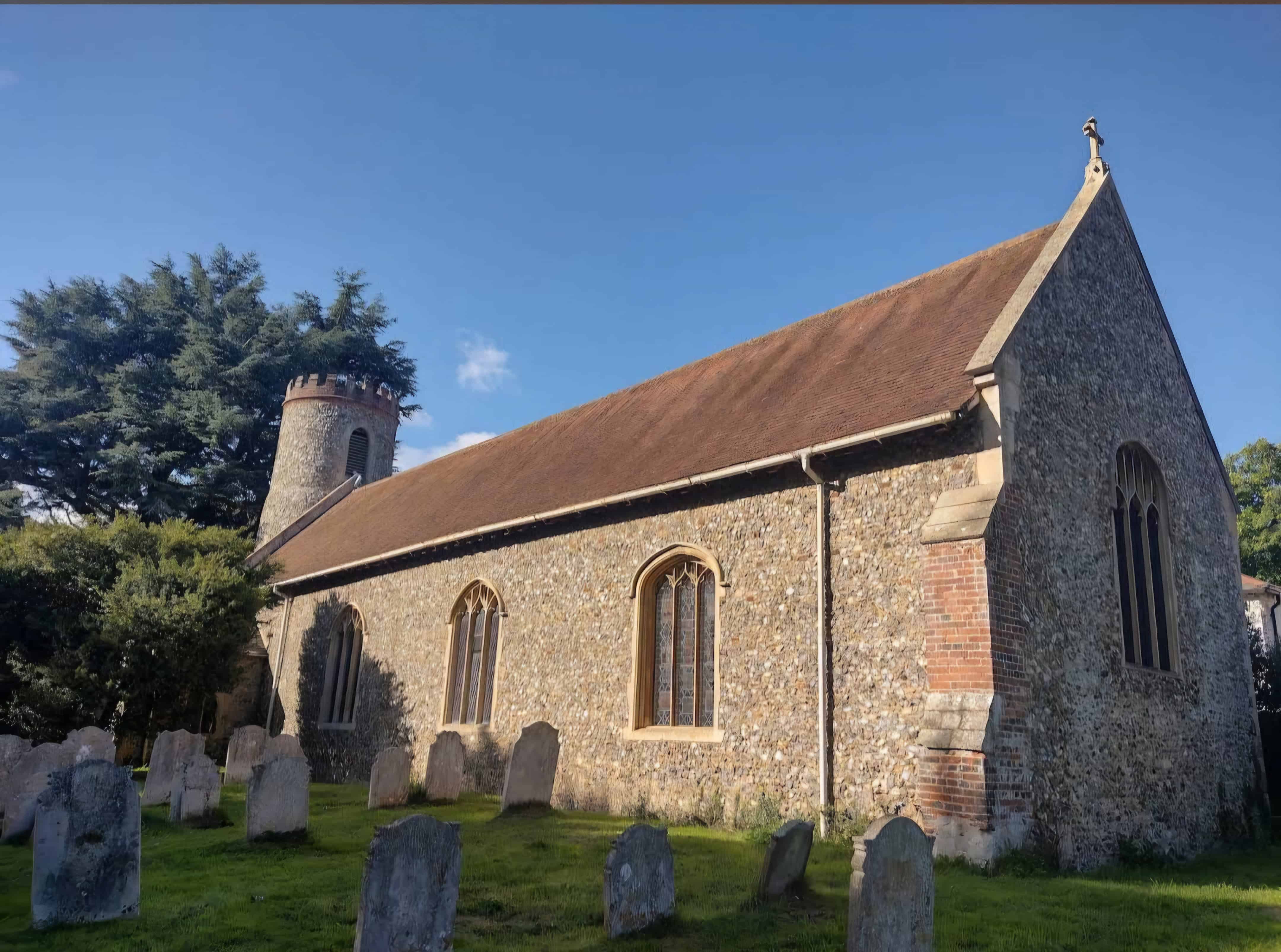
What a truly special day! Yesterday, I had the pleasure of photographing the beautiful christening of little Ruby at the charming Church of St Gervase and St Protase in Plumstead, Norfolk. The church itself was so picturesque, a perfect setting for such a meaningful occasion steeped in history and with direct connection to the family themselves.
Early Origins:
- The church likely dates back to the Late Saxon period, with its round tower and nave being of Norman origin.
- The round tower, a characteristic feature of Norfolk churches, was likely built in the 11th century. Traces of three blocked circular openings are visible inside, below the nave ridge.
- The nave also has 11th-century origins.
Medieval Period:
- The belfry was added to the tower, possibly in the 13th century, with alterations made to its openings in the 19th century.
- A 13th-century arch is now blocked on the north side of the nave.
- A brass in the floor north of the altar commemorates Sir Edward Warner, who died in 1565 and was Lieutenant of the Tower of London in 1552.
- Another brass in the northeast corner of the sanctuary depicts a civilian and his wife, dating back to around 1480, possibly for Robert Latham, who died in 1479.
- The south porch was constructed of brick in the 16th century, with subsequent repairs.
Later Modifications and Restorations:
- The north wall of the nave was rebuilt in the 17th century using brick and incorporates a reset small stone window, potentially Norman.
- The brick parapet on the tower was added in the 19th century.
- Most of the windows in the nave and chancel feature 19th-century stonework, likely from mid-Victorian restorations around 1851.
- The chancel has 18th-century brickwork on its north side.
- The east and south windows of the chancel are 19th-century Perpendicular in style.
Unique Dedication and Interesting Features:
- The church’s dedication to St Gervase and St Protase, twin brothers martyred in Milan in the 2nd century, is uncommon in England, and this church is likely the only one with this specific dedication. They are the patron saints of haymakers.
- The south door is rounded with an 11th-century billet moulding.
- The south chancel window contains a selection of old glass, including four rare square painted glass panels made in Lowestoft by Robert Allen (1745-1835) depicting the Evangelists. It also features two possibly 17th-century German grey and white panels and enameled squares and roundels by H. Samuel Yarrington (1781-1846).
- Outside the south porch once stood an 18th-century stone “bird bath” font ( unfortunately damaged and no longer there) believed to have been used before the 20th-century font currently inside.
- Inside, a replica of the brass for Sir Edward Warner is available for brass rubbing.
In summary, the Church of St Gervase and Protase is a building with significant historical depth, showcasing architectural elements from the Norman period through to the 19th century. Its unique dedication and collection of historical artifacts, including brasses and old glass, add to its special character.
Early 17th to Early 18th Century: A Non-Conformist Chapel Interestingly, the barn wasn’t originally built as a barn at all! It’s believed to have been constructed sometime between the late 1600s and early 1700s. Due to a lack of precise builder’s records, the exact date is uncertain. Its initial purpose was as a non-conformist Methodist meeting chapel. The distinct eight-sided shape was part of its original design, topped by a grand, open vaulted octagonal roof, creating a large central space.
Later Use as a Farm Building Over time, the building transitioned to agricultural use, becoming part of Manor Farm. It served various functions typical of a farm barn, including grain storage and stabling for horses. There’s even a record from 1853 in a great-grandmother’s diary mentioning harvest parties held in the barn, with large gatherings, food, and ale.
Rare and Significant Structure The Octagon Barn is considered a rare and important survival, with its octagonal design being unusual for agricultural buildings. It’s noted as possibly being one of only five such barns remaining in Norfolk.
21st Century: Restoration and Event Venue For some time, the barn fell into disrepair. However, in recent years, it has been lovingly restored and converted into a multi-use function venue. It now hosts a variety of events, including weddings, conferences, and parties, showcasing its impressive structure and acoustics. In 2019, it even transformed into an opera house for the “Into Opera” festival, highlighting its versatility.
Today, the Octagon Barn stands as a Grade II listed building, a testament to its unique history, having served as a place of worship, a working farm building, and now a prominent event space in the Norfolk countryside.